This week, children from across England and Wales returned to school. Scottish children went back a few weeks ago. And soon, thousands of older students will be heading off to colleges and universities. With the new academic term underway, this week's post looks at notable contributors to British education.
 |
| King's College Chapel, Cambridge (By Andrew Dunn - http://www.andrewdunnphoto.com/, CC BY-SA 2.0, https://commons.wikimedia.org/w/index.php?curid=1340715) |
The city of Cambridge in East Anglia is famed worldwide for its contribution to academia and the advancement of education at all levels. Burial and cremation records from the city have been in our database for a number of years.
Deceased Online's Cambridge City Council Collection includes:
- Cambridge City Crematorium. Huntingdon Road, Girton, Cambridge CB3 0JJ (from 1938; no addresses or places of death are revealed on records from the past 13 years)
- Newmarket Road Cemetery (Cambridge City Cemetery), Newmarket Road/Ditton Lane, Cambridge CB5 8PE (from 1903)
- Huntingdon Road Cemetery (on the same site as the City Crematorium; from 2003)
The collection includes the details of many notable academic and innovators. Amongst these is
(Charles) Martin Robertson (11 September 1911 - 26 December 2004), a poet and celebrated classical scholar, particularly of Greek art. After graduating from Trinity College, Cambridge, Robertson worked in Athens as a student of the British School, then worked at the British Museum. He served in the Second World War and then returned to the museum. In 1948, Robertson accepted the post of Yates Professor of Classical Art at University College London. He last post was at the University of Oxford. He is remembered for his books,
Greek Painting (1959) and
A History of Greek Art (1975). Martin Robertson died at the age of 93 and was buried in the City Cemetery.
 |
| Cropped Entry for Charles Martin Robertson in the Register of Burials at Cambridge Cemetery |
On the other side of city from the cemetery is Cambridge Crematorium. This was opened in 1938 (with what is now the East Chapel) by a private company and taken over by Cambridge City Council in 1951. In 1991, a second chapel, the West Chapel opened.
 |
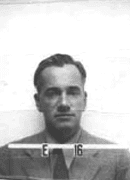
| Los Alamos Identity Badge Photograph of Otto Frisch (1904-1979) |
Among the notable academics in the cremation records is
Otto Robert Frisch (1 October 1904 - 22 September 1979). Frisch was an Austrian Jew who left Vienna for London in 1933 after Hitler's accession to the chancellorship of Germany. In London, Frisch worked at Birkbeck College with the physicist Patrick Maynard Stewart Blackett. Following this he worked in Copenhagen with the renowned nuclear physicist Niels Bohr. In the first part of the Second World War, Frisch was based at the University of Birmingham. In 1940, with his collaborator, Rudolf Peierls, Frisch designed the first theoretical mechanism for the detonation of an atomic bomb. After being made a British citizen in 1943, he was sent to Los Alomos in New Mexico, USA to work on the Manhattan Project. In 1946, he arrived back in England. After a brief period at the Atomic Energy Research Establishment at Harwell, Frisch settled in Cambridge teaching as Jacksonian Professor of Natural Philosophy and a Fellow of Trinity College.
Are you excited about the new academic year? Do you have any teacher or academic forebears that you have found in the Deceased Online database. As ever, we love to hear about your discoveries. Please do share with us in the Comments Box below or on our Facebook and Twitter portals.


Comments
Post a Comment